The New Rules to Accumulate Wealth in the Next 10 Years
- Hotcup

- Mar 7, 2021
- 6 min read
Updated: Apr 11, 2021
Before we begin, let’s look back on the past 200 years history on the world’s innovation transformation.

During the course of time, human has experienced four major innovation transformation in history. Thanks to the concurrent evolution of the telephone, automobile and electrification, the early 1900s were technologically momentous. Human productivity since then exploded, and that results in a radical change in the way the world operates.
First wave in 1800 – Steam engine
Second wave in 1900 – Telephone, car and electricity
Third wave in 1985 – Computer
Fourth wave in 2005 – Internet
Fifth wave in 2020 – Pandemic spurs a burst of technological innovation
Today, I believe the global economy is experiencing the LARGEST technological transformation in the history: blockchain technology, genome sequencing, robotics, energy storage, autonomous vehicles, artificial intelligence, space exploration, 3D printing, edge computing, 5G/6G telecommunication, AR/VR, Internet of Things (loT) and precision medicine – all of these innovation platforms are evolving and maturing in the same period, right now.
Each of these transformative technologies are approaching their tipping points as significant costs started declining due to increase efficiencies coupled with incremental market demand. In the next 15 to 20 years, these innovation platforms will span across and combine to transform the global economy extraordinarily, in ways little understood today. How technological innovation can bring us wealth?
With such remarkable growing speed in the tech innovation, the transformation has grabbed the attention of the public and investors. Back in 2005, when retail investors attempted to snitch investment opportunity on the revolution of Internet wave, they needed full-service brokers or remisiers, who charged sky-high commissions for stock trading and investing advice.
Now, with the advent of online stockbroker, retail investors can easily enter trades for a fraction of the former cost, with just a click away. So, how can investors benefit from the current technology transformation? Let us explore using a simple diagram below.
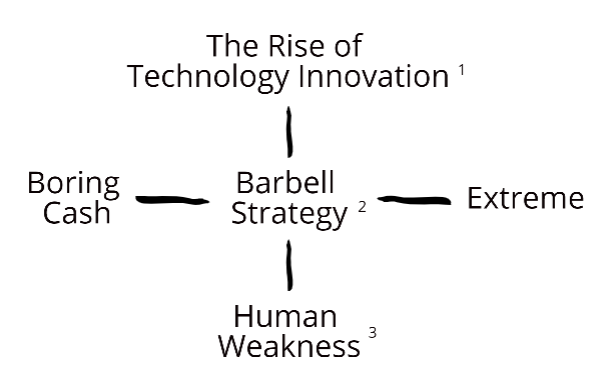
1. Let’s Start with the Rise of Technology Innovation
Tech innovation usually requires a substantial time to improve and nurture before gaining mass market share. The S Curve model below depicts how innovation starts slow in the beginning (heavy investment phase) to an accelerated phase as it proliferates, and then diminishes when performance ceiling is reached coupled with competition, and finally consolidation as the technology matures. At any point of time, there may be a radical innovation resulting in a new S-curve.

However, when the next wave of technology evolves, it does not necessarily indicate that the previous technology is going to cease, some of them may eventually innovate at scale and hop on to the new S curve. Unfortunately, not all companies can survive through transformation, as some are unable to keep up with the competition which may lead to stagnation or obsolescence. That’s why putting fund in these companies are always considered as high-risk investment in the investors’ world.
Why now?
According to Ark Invest estimates, these innovative platforms will generate more than $50 trillion in business value and wealth creation over the next 10 to 15 years. Today, they account for less than $6 trillion in global equity market capitalization, giving investors an opportunity to capitalize by 10-fold if they would have positioned their portfolios on the right side of innovation. Pandemic became the greatest accelerator of the century for technology transformation, despite the world has yet to notice the upcoming largest technology wave in the human history.

Technologies such as blockchain, adaptive robotics and neural networks are visioned as sectors with mega market opportunity (i.e. >$10 trillion market capitalization). It is highly recommended for my readers to look up on these innovative technologies.
What will happen to the world if blockchain is slowly replacing our existing financial institutions? While adaptive robotics facilitate many industries that are facing labour shortage, does it imply that robots will be replacing manual labours or perhaps new employment opportunities will be created for existing labours? How does neural networks or deep learning help in hyper-personalized customer experience?
Are these current transformative technologies as impactful as electrification in the 1900s or the steam engine in 1800s? Or much more than that?
Many investors perceived companies that are developing innovative technologies as risky and volatile. I strongly agree with that, but these companies are growth stocks which might evolve into an important source of return over a long-time horizon.
2. How do we invest using Barbell Strategy?

Nassim Taleb portrayed an image of barbell to describe a DUAL attitude in life by taking extreme risk aversion on one side and extreme risk seeking on the other, whilst eliminating all “moderate” risk attitude. In finance, with an investing barbell, one would have “high risk – high return” investment on one sleeve and “low risk – low return” on the other sleeve. No “medium/moderate risk” investment should be in our portfolio as Taleb argues that medium risks can be subjected to huge measurement errors.
A simple illustration would be placing 90% of funds in boring cash (preferably inflation resistant asset), and remaining 10% in a high-risk investment, i.e. worst-case scenario you cannot possibly lose more than 10% of your total investment. Using this strategy, Taleb focused on minimizing loss (not maximizing return) since NO ONE can ever predict where the market is going. The only way to increase our resistance to adverse events will be to reduce our financial vulnerability. In other words, by applying Barbell Strategy, investors can protect their financial position during bad times and being heftily rewarded during good times.
Back to technology innovation as described earlier, placing your fund in these tech companies are considered high-risk. Whereas for low-risk investment, Taleb argues any form of investment that removes the risk of ruin (e.g. blue-chips stocks) is considered as low-risk investment.
Why are some investors not benefiting from this?
Investors tend to find it difficult to balance between growth and volatility. When the market fluctuates, especially during market dips, investors often pull back from stocks related to innovation due to fear and uncertainty. As shown in below graph (red line), only few early investors held on to the company shares when the company successfully achieve substantial market penetration in the later stage.

For stocks associated with innovation and technology, if investors are expecting to achieve 10 times return in 3 years horizon, then they probably should not sell off their shares when there’s a 50% unrealized loss in the first 6 months. Investors tend to OVERESTIMATE the performance of tech stocks in the first 6 months but UNDERESTIMATE its achievement in the next 6 years. Of course, there’s no guarantee that these companies will achieve their shareholders’ expectation due to their business nature. Investors have to be prepared to lose 100% of their investment (thankfully this is capped at 10% of our portfolio), which is why investing in tech company always comes with high risk.
Despite applying barbell strategy, if these stocks are extremely high risk, why should we invest in them? There is a saying that, you can never make money beyond your knowledge. As the world progresses, this quote may not be relevant soon. The pace of technology advancement is way too fast, and majority of us can hardly keep up with the changes in today’s cutting-edge technology.
Here comes the idea of Taleb’s “convexity”. If a process is convex, it has a huge upside potential and limited downside risk. Take a look at this graph below. By limiting 10% of your funds in these hardly-understood-high-risk-investment, the maximum loss you will put up with is 10%, however, if it goes right, you will earn outsized returns from these investments. In short, the downside is limited but the upside is unlimited.


3. Human weakness
"Bulls make money, bears make money, pigs get slaughtered" is an old Wall Street saying that warns investors against excessive greed. Investing is never about gambling. Seasoned investors understand that the greatest achievement for them is to stay survive through stock market ups and downs on a long-term horizon.
Therefore, despite being very confident on a golden trade opportunity that “guarantee” at least 100% return, investor should never opt to “all in” their savings. If you successfully profit from the first trade, you might eventually lose everything in subsequent trades. Remember to stick to your long-term financial plan and leave your investments alone.
Hotcup’s Verdict
Looking at the recent dip for tech stocks, it did cross my mind that whether bubble burst 2.0 is approaching. No doubt, these risky investments remain volatile in the short run and definitely not advisable to blindly pursue the “best performing stocks” in the market based on recent share price performance. It is always crucial for investors to adopt a sustainable investment strategy, such as barbell strategy to achieve a balanced investment portfolio in both bull and bear markets in the long run.


![[July 2021 Update] StashAway Simple is not that simple after all](https://static.wixstatic.com/media/d6c11b_9b1371a1676a464a836a040aea4a63d8~mv2.png/v1/fill/w_980,h_980,al_c,q_90,usm_0.66_1.00_0.01,enc_avif,quality_auto/d6c11b_9b1371a1676a464a836a040aea4a63d8~mv2.png)

Comments