Revealing My REIT Passive Income Portfolio
- Hotcup

- Mar 13, 2021
- 3 min read
Investing in REITs is one of the simplest ways for investors to generate passive income. When public listed companies or REITs generate profits, a portion of these profits are paid by the companies to its shareholders in the form of dividends.
I absolutely love to receive dividends as a source of passive income in the long run. Currently, around 16% of my total investment is allocated to REITs whereby 66% are invested in KLSE stock market (M-REITs) and the rest in SGX stock market (S-REITs).
Today, in this article, I am so excited to share with you all details regarding my M-REIT and S-REIT portfolio!
1. REIT Portfolio by Country
In the beginning of my REIT investing journey, I started with M-REIT as I am more familiar with the overall economy and real estate condition of the local REITs. When my savings increase over time, I wanted to expand my REIT portfolio by increasing overall weightage on the international real estate market as well.
Investing S-REITs is one of the great options for investors who are looking for foreign exposures. Why? Singapore is the only REIT market in Asia that has international REITs expanding out of Singapore to China, Australia, Europe etc. Not to mention, there is NO TAX charged on dividend received from REITs listed on SGX.
Below is my REIT portfolio weightage by country as of 28 Feb 2021.

2. REIT Portfolio by Industry
As depicted by diagram below, 71% of my portfolio is allocated to industrial and logistics real estates which situated in both Malaysia and China. Industrial REITs generally cover warehouses, factories, manufacturing facilities, storage facilities etc.
I have a strong conviction on industrial and logistics REITs as I believe there will be a higher demand for warehouse and industrial real estate amid an accelerated adoption of e-commerce, coupled with the recovery of manufacturing sector.
Besides, I love the feature that this segment requires tenants to sign on longer-term leases which include rental escalation clauses.

3. REIT Portfolio by Company
Currently, I am holding four individual REITs which consist of Axis REIT (MY), EC World REIT (SG), KIP REIT (MY) and Mapletree NAC REIT (SG). As you can see below, my largest REIT holding is Axis REIT, mainly because of their decent job in expanding their industrial property portfolio, while at the same time maintaining a stable tenant base.

M-REITs
For Axis REIT and KIP REIT, read this article here to understand the reason why I decided to invest in them.
S-REITs
For EC World REIT and Mapletree NAC REIT, their properties are mainly industrial, retail and office buildings that situated in China, Hong Kong, Japan and Korea.
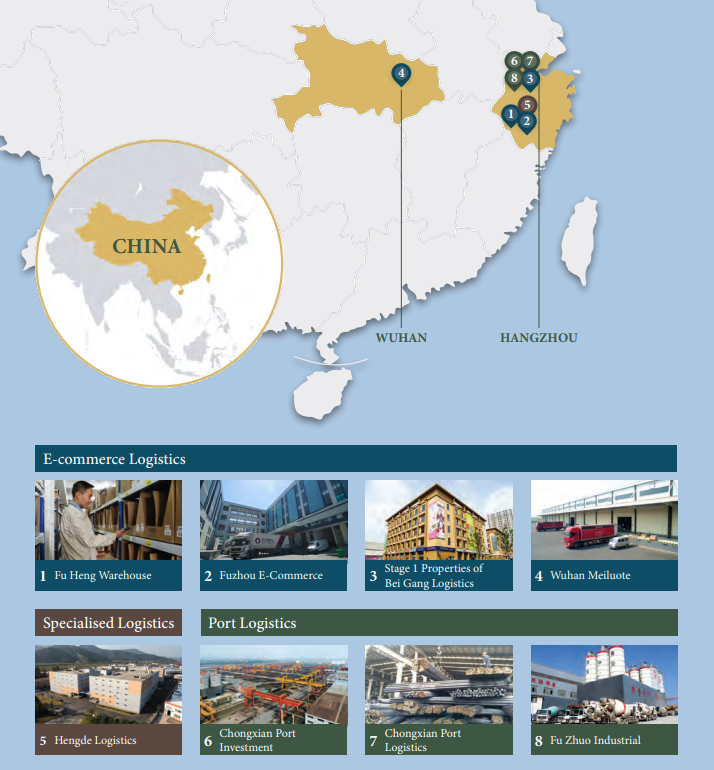
EC World REIT has a diversified portfolio of 8 income-generating real estates in Hangzhou and Wuhan, China which are used primarily for e-commerce, supply chain management and logistic purpose. I love its property portfolio which caters to the fast-growing logistics and e-commerce sector. Besides, the built-in lease rental escalation at regular intervals also enable a strong growth in future earnings.
Mapletree NAC REIT (MNACT) is the first REIT in Singapore that offers investors the opportunity to invest retail and office properties that situated in China, Hong Kong, Japan and Korea. The REIT portfolio comprises of 11 properties – 1 retail mall with office components in HK, 2 office buildings and business park in China, 7 office buildings in Japan and 1 office building in Korea.

Additional Information about My REIT Portfolio

Hotcup’s Verdict
Here comes to the question on how we identify any outstanding REITs as there are so many options out there in the stock market. Below is a summary on my criteria to select my
“favou-REIT”. You may get all the information easily in the REITs’ annual reports.
- Increasing net property income over the years
- Gearing ratio below 40%
- Increasing distribution per unit over the years
- Average occupancy rate (at least 90%)
- Good future prospect
- REIT is undervalued when NAV is lower than share price
Lastly, remember patience is the most important virtue for investors. Slow and steady wins the race!


Disclaimer: I am neither an expert nor certified trader, and the views contained in this post should not be taken as an indication to buy or sell. I will not be held liable for any gains or losses incurred as a result of one's individual investing decisions after reading this post.

Comments